Our industry is a unique one, built around the narrow tolerances of perishability, a cold chain and a value chain that must be orchestrated perfectly at every step, and all the while fielding weather and market conditions no one controls.
There is simply not a manual to read or a cheat sheet to consume that can adapt the everyday food professional to the wild world of fresh produce. You need a map. And as an industry that leans on tradition modernizes with today's technological tools, the terrain keeps shifting.
For anyone who has traveled the wilderness, a map is a start. A guide who has already walked the ground is what makes it useful. Together, they can carry a company toward real transformation, and the resilience to hold on to it.
Now, the guide.
RSM's Kevin Head, Director of Food and Beverage, brings a team of progressive minds and a track record of sharp execution to map out the way ahead. Here, Kevin shares where the industry stands today, and where RSM meets it.
Please read these words from the Director himself...

 The fresh produce industry moves very fast, and outdated technology makes it harder for any organization to keep up. Buyers expect lot-level traceability on demand, weather can change supply plans in hours, and FSMA 204 has made recordkeeping part of daily operations. Tight margins leave no room for slow decisions, disconnected data, or systems that were not built for how fast the produce business moves today.
Here is the pattern we see again and again. A produce company is running a legacy ERP system, then surrounds it with spreadsheets, a bolt-on for traceability, a separate tool for quality, and a string of manual processes to hold the whole thing together. None of those pieces were built to talk to each other. They were added one problem at a time, and now the problem is the space between them.
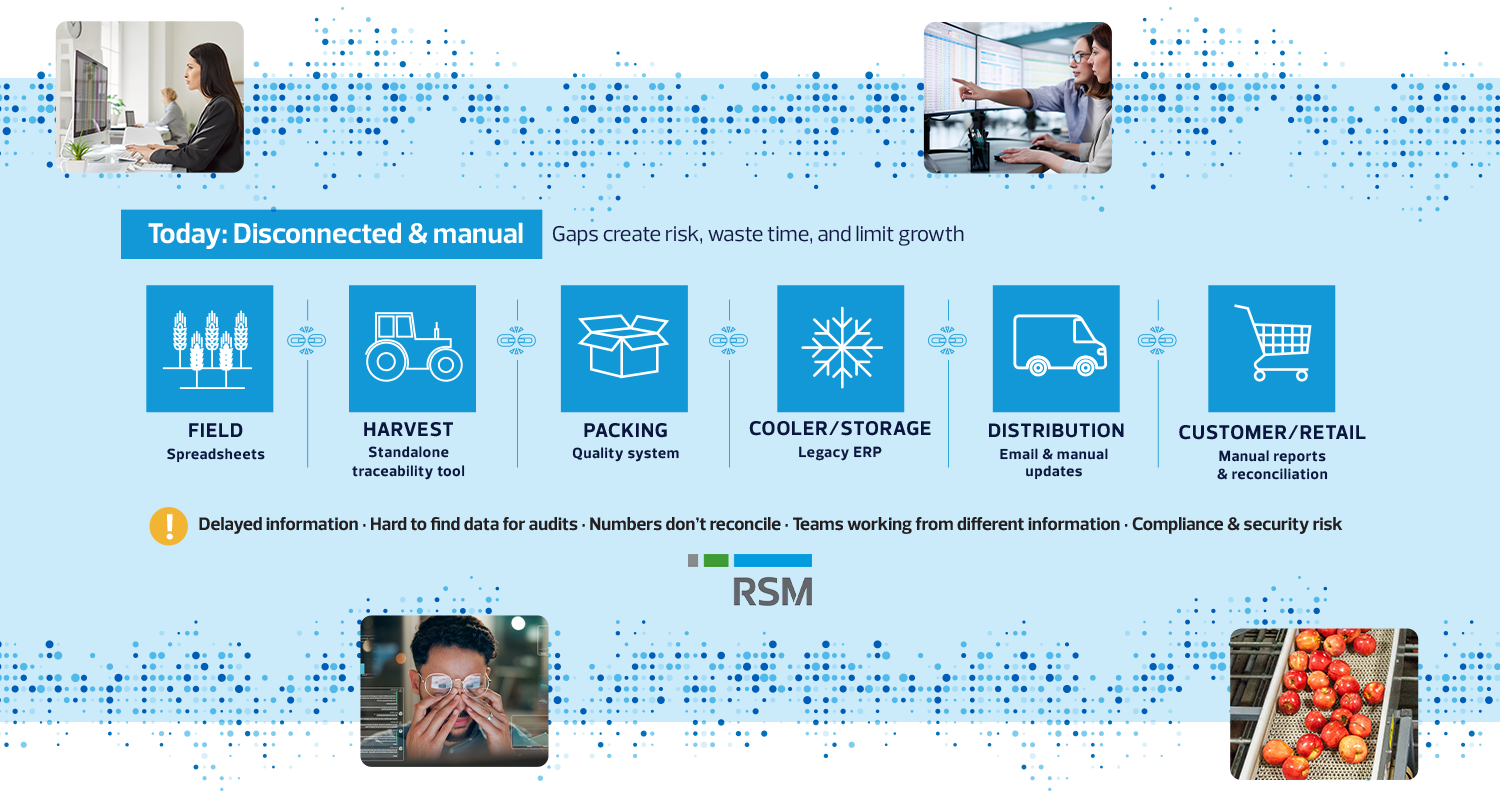
Many leaders assume a better ERP will solve the problem, but ERP is only one piece of a larger operating environment. The real inefficiencies often sit between systems, teams, and processes.
Timing is one of the first pain points to show. With batch processing, afternoon numbers may already be hours old. In a business where product value shifts quickly, that delay can cut directly into margin
The same issue appears in the search for one source of truth. Finance may use one set of numbers while operations use another, forcing teams to reconcile both in spreadsheets. When field, cooler, and invoice data conflict, leaders are guessing which version is right.
Traceability creates another problem. The data that proves where a product came from and where it went often lives outside the system of record, in a standalone tool or shared file. When a regulator or retailer asks for it, teams have to go searching.
Underneath it all is rigid software built for parts on a shelf, not strawberries in a cooler. Produce moves fast and loses value faster. Most systems were not built for that.
Smart teams usually find ways to work around these issues, but that is part of the problem. Because those workarounds may work in the moment, it is easy to miss what they are really costing the business long term.
A controller rebuilds the same report every Monday because the system cannot produce it. A quality manager keeps the audit trail in a personal spreadsheet because the ERP has nowhere to put it. An operations lead reconciles three systems by hand before a shipment goes out. Every one of those habits burns hours that should go to the business, and every manual touch is a chance for a number to go wrong.
The compliance and security risks are clear. When traceability data lives in unmanaged files, audits turn into searches through disconnected records, while sensitive supplier terms, pricing, and customer data can sit exposed in spreadsheets. Companies cannot protect data they cannot see, and many no longer know exactly where it lives.
You do not need a formal study to know whether this is you. Run through this short list and see how many of these situations are applicable to your business:
If three or more of these sound familiar, your technology may be limiting the business rather than helping it grow.
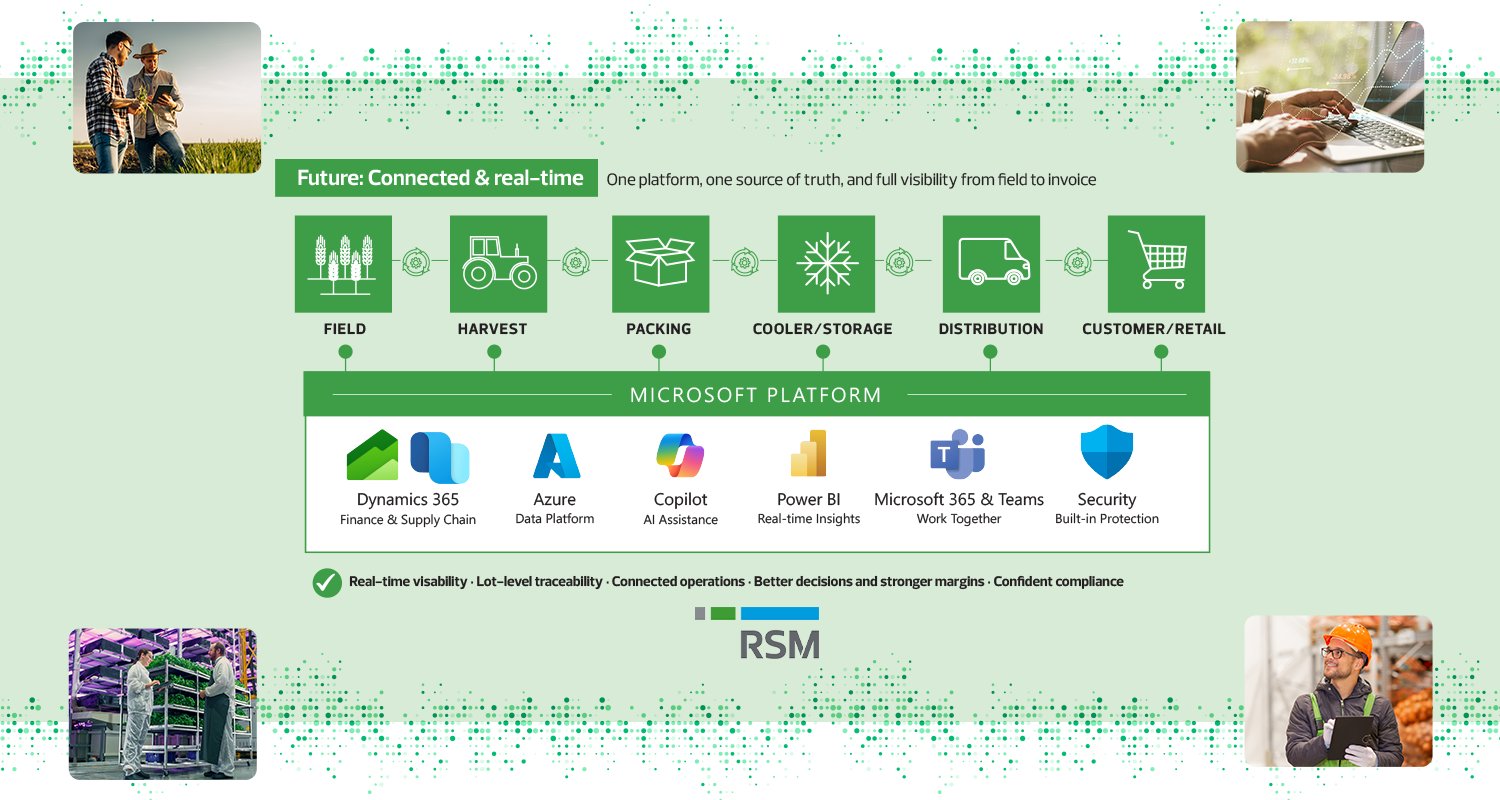
The fix is not another point tool. It is a single source of truth where finance, operations, and compliance all draw from the same place.
A Microsoft platform can connect the work around how produce businesses operate. Dynamics 365 brings finance and operations into one system, while Azure creates a shared data foundation for the field, plant, and back office. Power BI turns that data into real-time visibility, Microsoft 365 and Teams keep people working from the same live information, and built-in security helps protect it all. The result is full visibility from field to invoice with fewer gaps along the way.
None of this means ripping everything out on Monday. The smartest first move is also the smallest one. Before you commit to any transformation, look at the whole environment, not just the ERP. Where does your data live? Where are the manual handoffs? Where is the risk? A platform readiness assessment answers those questions in weeks, not quarters, and hands you a clear, honest picture to plan from.
The produce industry kept evolving. Your technology can too. The first step is simply seeing what you are working with.
Explore how RSM helps food and beverage organizations build connected finance, supply chain, and data capabilities that support long-term growth and AI initiatives: Microsoft for Food & Beverage.